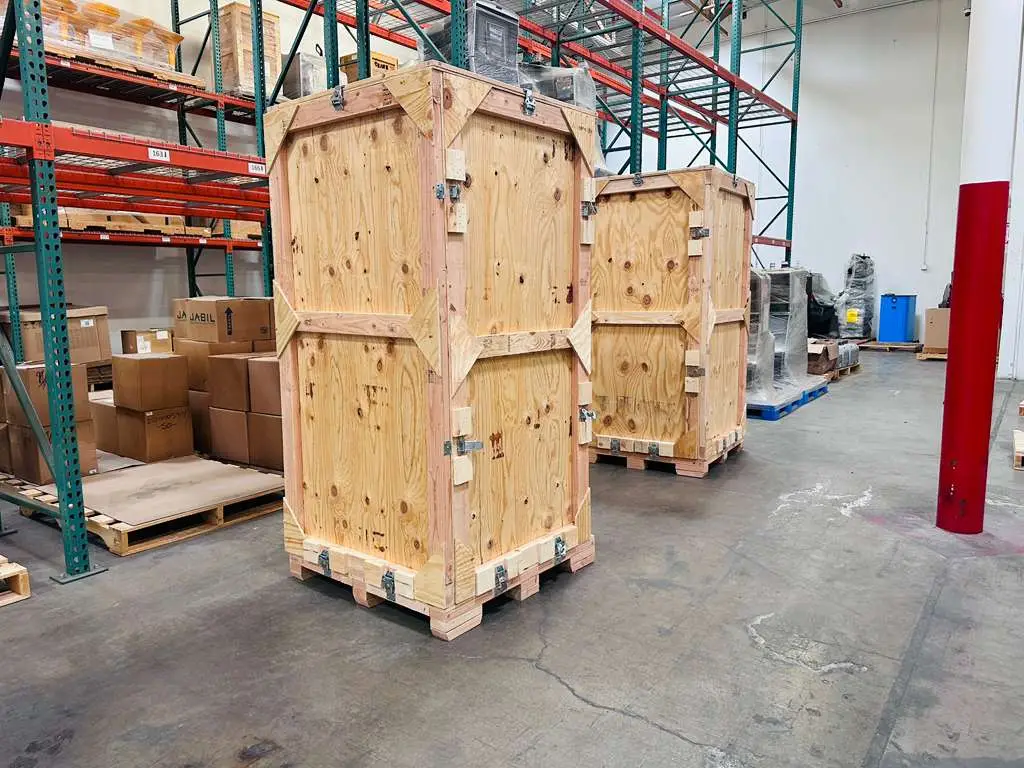
Consolidated freight travels alongside other people’s cargo, gets restacked at least twice between origin and destination, and is handled by forklift crews who have never met your product and have no idea what is inside the box. That is not a criticism of the crews. It is simply the nature of groupage: your pallet shares a container, a warehouse floor and a tail lift with somebody else’s.
We investigate every damage claim by cause rather than just by liability, and the pattern is remarkably consistent. Almost all of it traces back to five avoidable decisions made in a despatch bay weeks earlier, usually by somebody working quickly with the packaging that happened to be on the shelf. None of the fixes below are expensive. Most cost less than a pound or a dollar per pallet, and all of them cost far less than a claim.
1. Pallets that are smaller than the load
Overhang is the single biggest cause of crush damage in consolidated freight. If cartons extend past the pallet edge, even by two or three centimetres, they take the full weight of whatever is stacked above them instead of transferring it down through the pallet frame. The corner carton always loses.
Overhang also makes a pallet impossible to handle cleanly. Forklift forks catch the bottom cartons, shrink wrap tears on the edges, and the load leans slightly further with every movement until it is no longer square. By the time it reaches a destination warehouse it looks like it has been dropped, when in fact it was simply the wrong shape from the start.
Size the pallet to the load rather than the load to the pallet. If your cartons genuinely do not fit a standard footprint, tell us at booking and we will price a bespoke pallet or a crate; it is cheaper than the alternative.
2. Stretch wrap doing structural work
Film holds a load together. It does not make a load strong, and it cannot stop a stack from racking sideways when a container rolls in a swell or a trailer brakes hard. We regularly see pallets wrapped ten or twelve times, as if quantity of film could substitute for structure, arriving with the wrap perfectly intact and the cartons inside crushed into a parallelogram.
Corner boards and horizontal strapping cost very little and change the physics entirely. Four vertical corner boards turn a soft stack into something with edges that can take compression, and two horizontal straps tie the tiers into one rigid unit. Add a top cap if you are stacking, so the strapping does not bite into the top layer.
Wrap should also start under the pallet deck. Film that begins at the first tier leaves the load free to slide off the timber, which is exactly what happens on a ramp.
3. Mixed carton sizes in one tier
Uneven top surfaces are invisible in the despatch bay and catastrophic in a container. If a tier is made up of two carton heights, the tier above sits on the two tallest corners instead of on a flat plane, and every kilogramme above concentrates into those points.
Keep tiers uniform wherever you can. Where you genuinely cannot, add a slip sheet or a sheet of double-wall board between tiers to spread the load, and put the heaviest, most uniform cartons at the bottom. It sounds obvious written down. It is still the third most common cause we record.
4. No moisture management
Containers sweat. Warm, humid air loaded at origin condenses on the steel roof as the box moves into cooler water, and rains back down onto the cargo. Cardboard loses a large proportion of its compression strength once it takes up moisture, so a stack that was perfectly adequate when it was loaded quietly becomes inadequate somewhere in the middle of the Atlantic.
A single desiccant bag per pallet, and a top sheet to shed anything that does drip, prevents the majority of it. For anything hygroscopic, anything with a bare metal surface, or anything shipped between very different climates, ask us about container liners and humidity indicator cards so you can see what actually happened in transit rather than guess.
5. Labels that only make sense to you
Internal part numbers, colour-coded stickers and handwritten references mean nothing to a handler in a transhipment hub who is looking at four hundred pallets and a scanner. If the shipment reference is not on at least two faces of the pallet, in large plain characters, it will be read from a manifest instead, and manifests are where two consignments become one.
Label two adjacent faces, keep the reference we issued on the label, and mark orientation and handling requirements with the standard symbols rather than in words. If a pallet must not be stacked, say so with a symbol and back it up with a top cap that physically prevents it, because a sticker alone has never stopped anybody.
Test it before you ship it
You do not need a laboratory to find out whether a pallet will survive. Three quick checks catch most problems: push the top tier firmly sideways and see whether the stack moves as one unit or shears, lift the pallet with a forklift and watch whether the bottom cartons deform, and walk around it looking for any carton corner that is carrying weight it was not designed for.
If you are sending a new product or a new packaging specification for the first time, send us photographs of the finished pallet before it leaves your building. Our packing crews will tell you within the hour whether they would put it on a vessel, and there is no charge for the opinion.
What we do at our end
Every pallet that passes through our facilities is photographed on arrival and again after loading, so if damage is discovered at destination we can show precisely what condition the goods were in when we took them and how they were secured. Where you would rather not carry the risk at all, our crews will repack, palletise, crate and label to a written specification, and freight packed to our specification sits under our handling responsibility rather than in the grey area of shipper-packed cargo.
Claims are a symptom, not an outcome. If your lane has produced more than one, ask us for the causes rather than the credit notes, and we will come back with a packaging specification designed for the journey your goods actually take. Email info@transatlantic-expres.com or call the freight desk on +1 507 201 9651, answered around the clock.